
Summary
The research collected 340 questionnaires and analyzed the data for the sake of understanding LGBTQ in the cultural context of China, where same-sex marriage is forbidden, and LGBT-related topics are censored. Though samples are limited, the results to some extent reflect the public opinion in the country—not in an optimistic way.

Pride Parade in Changsha, 2013, which has been strictly banned in China now
Introduction
According to House and Javidan (2004), culture is a broad concept constructed by “shared motives, values, beliefs, identities, and interpretations or meanings of significant events that result from common experiences of members of collectives that are transmitted across generations” (p. 15). In other words, culture is the sum of people’s interpretations of the world as well as themselves within a certain group. The form of culture and cultural products is not limited and culture can be inherited from generation to generation. When it comes specifically to Chinese culture, which is the background of this paper, we can apply this definition of culture as well: Chinese culture refers to Chinese people’s interpretations of the environment they live in—China—as well as themselves, including their attitudes towards different things and their own identities.
Indeed, a person’s sexual orientation also belongs to his or her identities. While most people in the world are heterosexual, which means they are attracted to people of the opposite sex, there also exist people whose sexual orientations are in the minority, for example, LGBT (stands for lesbian, gay, bisexual, and transgender). While LGBT civil rights movements are flourishing all over the globe, homosexuality, which refers to the sexual orientation in which a person is sexually attracted to individuals of the same sex, is also under heated discussion in China. However, in many people’s eyes, Chinese people’s attitudes towards homosexuality seem negative. Specifically, they believe that Chinese people tend to prejudice or discriminate against gay people. In his 2017 article, Walsh, an editor at Sixth Tone, which is an online publication producing news about China, wrote that some Chinese people consider homosexuality “a grave threat to national security” (para. 10). Some news media in China also reported that gay people were more likely to be condemned and attacked on campus than others (“Xiaoyuan tongxinglian” 2012, para. 2).
It is true that my colleagues and I who have been working on this research have more or less witnessed certain discriminatory speech against gay people on social media such as Weibo, which is regarded as the Chinese version of Twitter. Nevertheless, we also saw various people supporting homosexuality by organizing online campaigns or making promoting videos, even though they were not gay themselves. To investigate this phenomenon from a cultural aspect, we created a survey to research on Chinese people’s attitudes towards homosexuality—as illustrated at the beginning of the paper, both their attitudes towards certain identities and these identities themselves can be considered culture. Since the Chinese law requires that a couple must consist of a man and a woman probably because monogamy of opposite sexes could ensure the transmission of the family line (Hu, 2016), homosexuality seems incompatible with such a legislation. In this way, this research could also help us understand Chinese culture from a legal perspective, as laws, created by humans, can also be considered part of culture.
Research Questions and Hypotheses
This research project is going to investigate Chinese people's attitudes towards homosexuality. For this project, we will mainly concentrate on the thoughts about homosexuality from students and their parents, testing the extent to which homosexuality is accepted by different generations. Although stereotypically homosexuality is not recognized by Chinese people and even commonly discriminated in Chinese society, this project aims to show that the situation varies among different people in China. Meanwhile, we want to answer the questions below through the research:
-
What is the real situation that Chinese gay people are faced with concerning social opinions? —i.e., how do Chinese people look upon homosexuality?
-
Do people pay attention to homosexuality or LGBT civil rights movements in China?
-
What are Chinese people’s attitudes towards LGBT civil rights movements?
-
How do people look upon the future of homosexuality in China? (for example, whether gay marriage will be legalized in China)
Primarily, we assume that Chinese people’s attitudes towards homosexuality might greatly differ among generations and our main focuses are the attitudes of parents and students. Specifically, we have the assumption that students might be more supportive of homosexuality and LGBT civil rights movements while these students’ parents would be more conservative or even opposed to homosexuality. The rest of the paper tries to address the research questions raised above.
Methodology
Survey
Since the research aims at exploring Chinese people’s attitudes toward homosexuality, all the survey items are developed surrounding this topic. We also include items asking participants about their opinions of LGBT civil rights movements and homophobia to get comprehensive information from various perspectives. Because we consider that different people might have divergent attitudes, we applied a category-type question (Question 2, see the full survey in the appendix) to divide the participants into three different groups: students, parents of students, and the category Others, which includes people who are neither students nor parents, such as relatives and friends of certain participants. Subsequently, we created different items targeting the three different groups. Specifically, there are three versions of Question 7 depending on the group that the participants belong to. The examples are as follows.
Q7. a. [For students] Supposing you are homosexual, would you tell this fact to your parents?
-
Yes, always
-
Probably yes, but I will keep hesitating
-
Probably not, but I will still sound them out
-
No, never
b. [For parents] Supposing you coincidentally get to know that your child is homosexual, would you support him/her?
-
Yes
-
Neither support nor oppose
-
No
-
I don’t know
c. [For others (relatives or friends)] Supposing you have a child and you coincidentally get to know that he/she is homosexual, would you support him/her?
-
Yes
-
Neither support nor oppose
-
No
-
I don’t know
To make our survey less time-consuming and easier to complete, the types of questions are multiple-choice, except for Question 8 and Question 14. Question 8 asks people about their thoughts on the causes of homophobia. It is a closed-ended question where participants can select more than one option, including an open-ended option for people to contain their own thoughts. With the help of Prof. Hiller, we have modified the answers to Question 8, which provide people with some possible causes of homophobia, to be more explicit and understandable. Question 14 is an open-ended question as followed, which gives participants a chance to freely include their opinions.
Q14. Do you have anything else that you want to add? (e.g., what do you think of the present situation of homosexuality—in any aspect—in China?)
We used Qualtrics, which is an effective online survey platform, to create and administer our survey. Through Qualtrics, we were able to set the type of questions and add display logic to different questions. Although this platform has numerous settings and functions, it is still relatively easy to operate since its user interface is clear and friendly. What is more, Qualtrics greatly assisted us in the data-analysis process. It can automatically generate a report including all the information and statistics we require. We could then easily adjust the format of the figures and charts of our survey results provided by Qualtrics.
Participants
We recruited the participants through two social media platforms which are commonly used in China: WeChat and QQ. Both of the platforms support online group chatting and individual chatting. We sent the survey link to several group chats, such as the group chats for DKU Chinese students and parents, and to individuals who are our friends, relatives or family members. Some of these individuals also shared the link with people they knew, which makes the sample relatively large and diversified. In general, a total of 340 people completed the survey, including 166 students, 93 parents and 91 people of the category Others.
Concerning the age range, a majority of the participants belong to two certain age groups: the 10-20 group (48.24%) and the 41-50 group (34.41%). There are also participants from other age groups, nevertheless, they take a relatively small proportion of the participants as a whole, among which 5.29% aged 21-30, 6.18% aged 31-40, 4.41% aged 51-60 and 1.47% are aged 60+. Such an age distribution in some way proves that the respondents belong to various generations, especially our generation and our parents’ generation, which supports us in exploring the divergent attitudes towards homosexuality between parents and students.
As for the education level, 66.76% of the participants have already earned or are earning a bachelor’s degree and 13.53% have a master’s degree or higher. Only 17.06% of the participants answered that the highest level of education they have received was high school, technical school or lower. This distribution shows that most of the participants are above the average educational level in China, which matches our requirement for the participants: educated.
Research Results and Discussion
The Results and Discussion section of the paper aims at answering the four questions raised in the introduction. More than focusing on homosexuality itself, these questions discuss how people look upon LGBT civil rights movements, which are significant channels for gay people to defend their rights and call for attention from the public. Through the four questions, people can have a thorough understanding of Chinese people’s attitudes towards homosexuality from different perspectives as well as the problems gay people are facing. These different attitudes as well as the identities in the minority are significant components of Chinese culture in the aspect of sex and gender. Meanwhile, since students and their parents to some extent represent two of the major generations in China, I will especially concentrate on the divergent attitudes between these two groups to gain an understanding of the social opinions that gay people might meet in China.

Concerning the first question—how do Chinese people look upon homosexuality—there is a clear division between attitudes of parents and children, which is consistent with our hypothesis. As indicated in Figure 1, approximately three quarters of the students (76.51%) regarded homosexuality as a normal sexual orientation while over half of the parents (52.69%) consider homosexuality an abnormal behavior or even a kind of mental illness, showing divergent attitudes. Since the age and identities of participants in the category Others are not fixed, they formed a distinct group which might overlap with the other two groups concerning participants’ attitudes. Therefore, this paper would not focus on this category when comparing the Students group and the Parents of Students group.

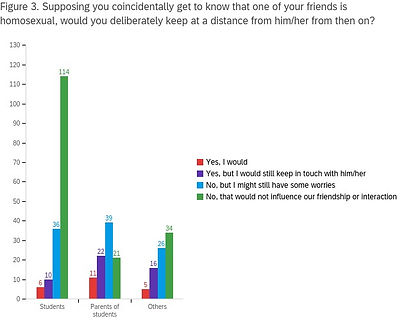
When parents were asked what their attitudes would be if their children were gay (Figure 2), few of them thought they would support their children with their sexual orientation (4.44%), while most believed they would not (56.67%). Interestingly, when it comes to their friends, nearly two thirds of the parents (64.52%) answered that if their friends were gay, they would not keep a distance from them (Figure 3), though most of these parents (65%) claimed that they might still bear some worries in mind. From my perspective, such a difference between parents' attitudes towards their friends and their children (if they were gay) reflects different levels of closeness inside different relationships—i.e., the relationship between their children and them is closer than that between their friends and them. While their children are their own flesh and blood as well as their most familiar family members, the relationships between their friends might be more distant and less solid in comparison. Meanwhile, I believe that such a difference somewhat mirrors the traditional idea in China that homosexuality will negatively influence the transmission of the family line because naturally gay people cannot have offspring. For example, if the only child of a family were gay and thus not willing to marry a person of the opposite sex, some family members might consider that the bloodline of this family would be cut off because of the sexual orientation of this child.

According to the responses to Question 7 (Figure 4), when students were asked whether they would tell their parents their sexual orientation were they gay, most of them (62.51%) thought they would not including several of them who even believed they would never tell their parents (11.88%), which I consider might be related to these students’ thoughts that their parents’ generation would not easily accept homosexuality. Though these kinds of thoughts may not be necessarily true, unfortunately, according to the results shown in Figure 2, the attitudes of parents to some extent supported the assumption that most of them at least would not favor such a sexual orientation.

Aside from people’s attitudes towards homosexuality in general and whether homosexuality is accepted in a family context, we also focus on the context of the whole Chinese society. We asked people about their opinions about causes of homophobia, which is a social phenomenon involving people who fear or discriminate against homosexuality. Moreover, we created a question concerning the social impact of homosexuality (Figure 5), asking people about their attitudes. While 41.23% of the participants showed a neutral attitude towards the statement that “homosexuality will harm Chinese society in certain aspects,” which takes the largest proportion among all options, attitudes of people from different generation seemingly differ. Since in most age groups the number of participants is not sufficient, I will still focus on the two major age groups that most of the students and parents are in, as described in the Participants section. In the 10-20 age group, about half of the participants (49.68%) disagreed with the statement compared to a few who agreed with it (12.58%), whereas in the 41-50 group approximately one thirds of the participants agreed with the statement (31.58%) compared to 16.67% who showed disagreement. To draw a comparison between the two groups, participants aged 10-20 tended to be more positive than participants aged 41-50 concerning the social impact of homosexuality. Nevertheless, this comparison is not as sharp as that in the question asking how people look upon homosexuality as a sexual orientation, probably because many adults tend to be more conservative about making judgements when talking about the topic of society. In other words, they might be more cautious about the choices that they are going to make or are actually not willing to respond to such a topic.

Actually, there exists a limitation in Question 9. While this question merely asked people about their attitudes towards the social impact of homosexuality, we did not record the reasons why people selected the options (Figure 5); thus, I would like to connect this question with people’s opinions of homophobia. As shown in Figure 6, over half of the participants considered that “the belief that homosexual relationships are wrong or abnormal” was a cause of homophobia, which is the most frequently selected answer though it cannot explain why people consider homosexuality harmful to society. What may explain why people regarded homosexuality as socially harmful (Figure 5) can be seen in the responses to Question 8 that nearly a quarter of the people (24.12%) deemed the cause of homophobia to be “the belief that homosexuality will affect the transmission of the family line or even end the family line because naturally gay people have no children.” Another possible explanation can be seen in the responses of the open-ended option in Question 8 that some people believed homosexuality might lead to the spread of AIDS. No matter whether the thought is true or not, it is at least one of the reasons that people think homosexuality would harm the Chinese society.


Our second research question tries to investigate how much attention the public have paid to homosexuality in China. As is seen in Figure 7b, the results indicate that a wide majority of participants (72.47%) would not intentionally search for information about homosexuality, though some of them reported that they would sometimes open those websites or messages if they saw relevant information. What is more, 91.18% of the participants who reported often searching for information about homosexuality are students (Figure 7a) and 66.67% of those who reported doing so seldomly are students, too. Combining this result with the previous ones, I would conclude that plenty of people who disapprove of homosexuality or regard it as abnormal actually did not pay adequate attention to it. Also, Figure 8 to some extent proves this argument: most people did not even hear of the movements related to gay rights. This lack of knowledge can possibly result in stereotyping or rigid opinions about homosexuality: people might form a fixed impression simply by hearing from others or observing from certain gay people and apply this impression to all the gay people as a whole.


The third research question—what are Chinese people’s attitudes towards LGBT civil rights movements—is based on the fact that LGBT civil rights movements are important channels for gay people to defend their rights, which, from my perspective, also means that homosexuality cannot be separated from LGBT civil rights movements. Therefore, this research question is in some way the extension of the first research question concerning homosexuality itself. As displayed in Figure 8, a great majority of the participants (92.26%) reported that they had never heard of any cases of LGBT civil rights movements in China. When it comes to their attitudes towards LGBT civil rights movements (Figure 9), over half of the participants displayed a neutral attitude, while 30.13% were supportive and 12.18% were opposed. In addition, only 35.58% of the participants believed LGBT civil rights movements would improve gay people’s lives in China (Figure 10). I would like to mention that among those who were opposed to LGBT civil rights movements in China, only one participant reported that he or her had really heard of such movements (Figure 9). Associating with the results of the second research question, a cause of discrimination and prejudice against homosexuality might be the lack of understanding and learning of it.


The last research question discusses how people look upon the future of homosexuality. Specifically, we asked them whether they thought gay marriage would be recognized and protected by Chinese laws in China (Figure 11). Among the participants aged 10-30, over half of them believed (53.57%) that gay marriage would be legalized compared to 16.67% who did not. Although many of the participants aged 41+ indicated that they don’t believe same-sex marriage might be legalized in future China (40.16%), still approximately one fifth of the participants in the 41+ age group (22.83%) believed in this possibility. This result in some way indicates a good tendency. What is more, from where I am standing, it is also possible that some participants who were opposed to homosexuality still admitted the likelihood of gay marriage being legalized.
Undeniably, there exist some limitations to our survey and the whole research project. To begin with, since our recruitment process mainly took place in WeChat and QQ group chats of our peers and parents, the number of responses from people aging 25-40 and 51+ might be a bit insufficient for us to further explore the relationship between Chinese people’s attitudes towards homosexuality and age. Meanwhile, though our main focuses are students and their parents, we did not set restrictions to the two groups. For instance, students can include people of all different ages including those who were in the same age group as our parents, since the concept of student is not fixed by levels of education. For another, we did not master the display logic well, which resulted in the loss of certain survey items in the distributed survey. Because of this fault, we were not able to investigate further into the reasons behind the attitudes of some people.
Conclusion
Generally speaking, the results of the survey fit our expectations well. The main component of our participants—parents and students—tend to show divergent attitudes towards homosexuality. We found that most young people in our survey have shown relatively positive attitudes towards homosexuality and LGBT civil rights movements while the majority of parents are negative or conservative about the topic. Meanwhile, we got to know that many participants of our survey, especially parents and previous generations, were lacking in knowledge of homosexuality and had limited understanding of LGBT civil rights movements in China. Indeed, the Chinese society in is still not inclusive enough for gay people to live in—they might face various discrimination and prejudice from the public and even misunderstandings from their own families.
However, the situation is transforming. As shown in the Results section, there is a trend that the new generation would be more supportive with homosexuality as well as LGBT civil rights movements. The exploration of such a trend might not change the Chinese society and the public opinions immediately, nonetheless, it could let more people know the challenges and problems gay people in China are facing. After obtaining a more thorough understanding of homosexuality, Chinese people might gradually change their attitudes, which would also help gay people in China fit in their own identities as well as the whole society. In other words, such exploration could assist with the consistency of positive attitudes towards homosexuality from generation to generation. Meanwhile, in the future, gay people in China might also be more confident to stick to their identities. As both attitudes and identities of Chinese people are significant components of Chinese culture, exploring this topic might also help people, including me, further dig into our own culture. Consequently, it is necessary to call for more people’s attention and aim at transforming their stereotypes in the long term.
Reflection
While at the beginning we simply wanted to dig into the topic of homosexuality in China and generalize people’s attitudes towards it, the results of our research provided me with a broader understanding of Chinese culture in various perspectives. For instance, I got to know specifically how different generations in China reacted to the same social phenomenon, which might reflect the different education levels and experiences of them. In the open-ended question, I also had the opportunity to hear from people of different identities and know more about their thoughts. Some people connected the legalization of gay marriage with the present situation of Chinese society, pointing out the importance of popularizing knowledge about homosexuality before adjusting laws. Others more or less explained why their approved of or disapproved of homosexuality, whose opinions in return broadened my horizons.
When it comes to the cultural aspect, I got to understand that Chinese culture indeed comprises diversified aspects and each aspect is deeply rooted in the history, geography, values and many other factors within China. What is more, though with the same cultural background, the opinions of Chinese people differed enormously. After analyzing the data, I could not help generating the thought that it is with all these differences inside a nationality that a national culture can be constructed—that is also how Chinese culture has been inherited continuously.
Last but not least, we gained much knowledge of creating survey items, administering a survey as well as analyzing data. Since a research paper can be considered an essential genre for academic writing, the knowledge and experience we obtained might also greatly assist us with future study. I learned that a good survey and data analysis should take various factors into account, trying to make connections between items to further explore the research topic. As a team, we also collaborated smoothly in presenting our ideas as well as analyzing our reports, although we could only communicate in the form of online chatting. Generally, taking online courses as well as participating in online communication in such a coronavirus period is indeed a precious experience for me. Conducting this research will also benefit me in various ways.
References
House, R. J., & Javidan, M. (2004). Overview of GLOBE. In R. J. House, P. J. Hanges, M. Javidan, P. W. Dorfman, & V. Gupta (Eds.), Culture, leadership, and organizations: The GLOBE study of 62 societies (pp. 9–28). Thousand Oaks, CA: SAGE.
Hu, X. (2016). Lun Zhongguo Yifuyiqizhi [Talking about the Chinese monogamy]. Fazhi Bolan, 2016(13), 222.
Walsh, M. (2017, Apr 27). Why Chinese nationalists have a homophobia problem. Sixth Tone, Retrieved from https://www.sixthtone.com/news/1000102/why-chinese-nationalists-have-a-homophobia-problem
Xiaoyuan tongxinglian qunti duozao gongji zhongguoren weihe kongtong [Gay people on campus are often condemned. Why are Chinese people homophobia?]. (2012, May 28). Fenghuang Wang. Retrieved from http://fashion.ifeng.com/emotion/topic/detail_2012_05/28/14857530_0.shtml
Appendix
See the attached PDF file.